
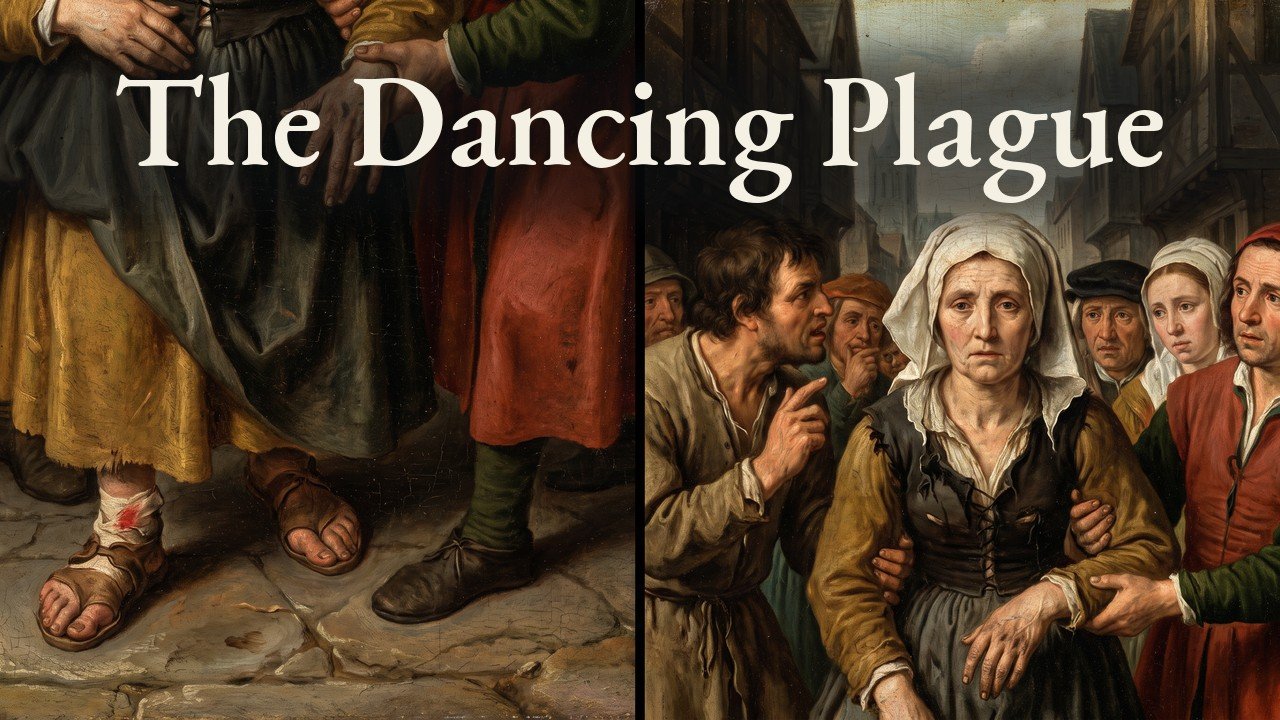
The story as it comes down
In the version told everywhere, it begins with one woman. In 1518, in the summer heat, a woman named Frau Troffea steps out of her house into a Strasbourg street and begins to dance. She has heard no music. She does not stop. Within days dozens have joined her, then hundreds; the city council, baffled, opens the guild halls to the afflicted, hires musicians, and sets strong men to dance the sick in relays until the thing is worn out of them. People dance until they drop. Eventually the sufferers are carted out of the city to a chapel of St Vitus and led in procession around the altar, and the plague, which has been given the saint’s name, subsides.
It is a very good story. It has a first patient, a municipal blunder, a saint, and an ending. The trouble is that almost none of those elements can be traced to any source close to the events, and the few that can are attached to a different year, a different city, or a different century.
What follows is what the record we hold actually contains, who said it, how close they stood to it, and where the trail runs out. Where the film had to run strands together to keep moving, they are separated again here.
One note, one rhyme
The nineteenth-century book that later writers on this subject kept returning to rests, for Strasbourg, on a citation the reader can follow. J. F. C. Hecker published Die Tanzwuth, eine Volkskrankheit im Mittelalter at Berlin in 1832. For the Strasbourg dancing plague he cites the chronicle of J. von Königshoven as edited by Schilter and printed at Strasbourg in 1698: note twenty-one, ‘von Veitz-Tantz’, page 1085. Kirchhoff said outright that he would base his discussion of the so-called dancing plague on Hecker’s account; William Osler wrote that for a full and accurate description of the dancing mania as it occurred in various countries Hecker’s work remains the standard authority; Dr Martin named him the recognised authority on the popular disease of the Middle Ages.
The note carries a few lines of rhyme. In Hecker’s reproduction it runs: “Viel hundert fingen zu Strasburg an / Zu tanzen und springen, Frau und Mann, / Am offnen Markt, Gassen und Strassen / Tag und Nacht ihrer viel nicht assen. / Bis ihn das Wüthen wieder gelag. / St. Vits Tanz ward genannt die Plag.” Many hundreds at Strasbourg began to dance and leap, woman and man, in the open market, lanes and streets, day and night, and many of them did not eat, until the raging subsided again; the plague was called St Vitus’s dance.
The verse about the Strasbourg outbreak reaches us in Hecker’s reproduction of that note, and the wording differs a little between the printings we hold. What it carries does not change: a scale - many hundreds - a setting, a duration of day and night, the detail that many did not eat, an ending, and a name, St Vitus’s dance. What it supplies is a crowd already dancing in the open market, the lanes and the streets, with no woman named in it and no first case described.
Later writers on this subject say openly that they are following Hecker. Theodor Kirchhoff stated that he would base his discussion of the so-called Tanzplage on the account given by Hecker in Die grossen Volkskrankheiten des Mittelalters, and then quoted him. The judgment that Hecker’s work remains the standard authority for a full and accurate description of the dancing mania as it occurred in various countries is carried in our record by William Osler and by the General-Anzeiger für Duisburg and the Walder Zeitung alike.
And Hecker himself did not wholly believe what he was transmitting. Deceit and depravity, he wrote, also carried on their dark game at Strasbourg - though he judged that the morbid delusion appears to have predominated, and that because of this only religion could bring provisional help. The founding account of the dancing plague arrives with its author’s own doubt attached to it.
1418, 1518, and a woman named Troffea
The date is the first thing that falls over. Hecker’s sentence gives the year: Strasbourg was visited by the Tanzplage in 1418. Etienne Trillat, in ‘Histoire de l’hystérie’, likewise records an epidemic of the danse de saint Guy at Strasbourg in 1418, and classes a Strasbourg dancing epidemic among collective phenomena. William Menzies Alexander has the dancing disorder ceasing after the great fourteenth-century outbreak and bursting forth again in 1418, with the possessed put under supervision and taken to the chapel at Rotestein, where masses were said for them and they were led in procession round the altar for the ejection of their demons. And the record carries the further claim, attributed, that by the time of the Strasbourg outbreak of 1418 the disease was already being called Veitstanz.
The 1518 date is not baseless, but its standing in our record is different in kind. Its fullest form reaches us through the Gießener Anzeiger, reporting a physician from Bad Nauheim, Dr Martin, on the dancing mania in Germany. According to that report, Dr Martin told his audience that according to his own researches in several documents it is established with certainty that the great Strasbourg epidemic broke out in 1518 and not, as individual chronicles have it, in 1418, and he named the Strasbourg city scribe Sebastian Brandt among his sources. The same report gives the details that are now standard - that eight days before St Mary Magdalene’s day a woman was the first to begin dancing day and night, and that after some weeks there were already two hundred afflicted - and our record sorts those particulars among claims repeated with nothing earlier behind them. The date itself is asserted elsewhere too: a London correspondent of the Deutsche Zeitung, printed in the Täglicher Baltimore Wecker, carries the 1518 outbreak; Kurt Kersten places similar occurrences at Strasbourg in the second decade of the sixteenth century; and a run of modern popular writers simply call it the Dancing Plague of 1518.
So in the Gießener Anzeiger’s summary of that lecture the modern date and the modern narrative arrive together, in one newspaper’s report of one evening, asserting a correction against the chronicles. That is a claim about documents rather than a document. Brandt appears in our record only as a name Dr Martin cited; we do not hold his words.
The two dates also pull the episode into different stories. On the first, Strasbourg is the late chapter of something already named: the affliction was being called the Veitstanz by the time of the 1418 outbreak. Kurt Kersten, for his part, reported similar occurrences at Strasbourg in the second decade of the sixteenth century, and held that economic hardship was the cause of that strange dancing epidemic. On either reading Strasbourg is not where this started.
The woman who begins the dance is the single most repeated detail in the modern story, and she is the one our claim record sorts most severely. That in 1518, in a small town in Alsace, a woman named Frau Troffea began dancing and did not stop is asserted as fact by later retellings - Ahadada Reader 3: four poets, and Jennifer Ashley Wright - neither of which, in our record, cites anything earlier. No source close to the events states it in these terms. The assertions that she was the first person to dance, and that she danced for four days, rest in our record on a single later writer, Mark Granier. What the record does carry, attributed, is thinner: Amie Jane Leavitt in ‘The Rhine River’, Jessie Greengrass and John Waller all assert that a woman named Frau Troffea stepped outside into Strasbourg and began to dance, and Waller adds that she had heard no music when she began.
There is a real difficulty here about what a first dancer would even mean. The Königshoven rhyme opens on many hundreds already in the market. Hecker wrote that people at Strasbourg fell ill after being seized by the sight of those already afflicted, and that those newly afflicted then followed the swarms of dancers unstoppably. On that model there is always someone already dancing. Which is one reason a viewer instinctively wants a Frau Troffea: the story needs a beginning the record does not supply.
What the city did, and what Basel did
Two accounts of the Strasbourg authorities’ response sit in the record, and they contradict each other on the most memorable point.
Hecker’s version is a pilgrimage. The city council, he wrote, took charge of the sufferers in a humane, philanthropic spirit; they were divided into separate groups and given responsible overseers so that no harm should come to them - and, he speculates, perhaps also to restrain the coarseness among them. So they were escorted, on foot and by wagon, to the chapels of St Vitus at Zabern and at Rotestein, where there were priests in attendance. After the service they were led in solemn procession around the altar and made to offer a small part of their alms. Hecker adds a point that cuts directly against the modern assumption that the shrines made things worse: at the time of this pilgrimage, he insists, the dancing mania did not renew itself at the altars of the saint; help was only entreated of him. Whether many recovered he offers as a guess - many may have been cured of their hopeless delusion through devotion and the holiness of the place. Georg Friedrich Daumer also records afflicted people being led to the chapels of Saint Vitus at Zabern and at Rotestein, where a religious service was held for them. Alexander, as noted, gives Rotestein and the procession round the altar.
Dr Martin’s version, as reported in 1913, is the one the internet knows. The council finally forbade all music. Then it resolved to give the sick the opportunity to dance until they danced themselves to death: the guild halls were placed at their disposal, music was provided, and strong men danced in turns with the sick until the sick were exhausted. Physicians, he said, prescribed contrivances in which the sick were spun and swung until they fell down unconscious. The sick were driven to St Veit, near Zabern, and led around the altar.
A ban on all music and the provision of music as therapy are not easy to hold in one hand. Both statements reach us from the same lecture as summarised by the same newspaper, and both sit in the category of claims widely repeated with nothing older behind them. Neither appears in the Königshoven rhyme.
What the record does contain is that the strong-men remedy was described as a real practice - elsewhere. Hecker, following the sixteenth-century Freiburg town physician Johann Schenck von Graffenberg, states that city authorities hired musicians in order to bring the attacks of the St Vitus dancers to a quicker end, and had strong men mix among the crowds to make their exhaustion complete, with often good results; and that authorities forbade the wearing of red clothing, because the sight of that colour drove the sick into such a rage that they rushed at people wearing red to do them harm. Something close to it is carried in English too: the authorities of some German towns, it was reported, held the opinion that music and dancing alone could effectively cure the dancing affliction. The rest of that English version - musicians hired to carry the dancers the more rapidly through their attacks, strong men sent among the patients to put them through the dancing with extra energy - comes from The Daily Dispatch of Richmond, Virginia, which cites nothing earlier for it, and no source close to the events in our record states it in those terms.
One instance of that cure is recorded by a physician writing from his own memory, and it is not Strasbourg’s. Felix Plater recalled from his youth that the authorities in Basel commissioned several strong men to dance with a dance-stricken girl until she recovered. One man relieved another. The cure lasted nearly four full weeks until she collapsed exhausted and, unable to stand, was taken to a hospital, where she recovered. She had remained constantly in her clothes, and, disregarding the pain of her danced-raw feet, had sat down only from time to time to take food or doze - during which the hopping movement of her body continued.
The Basel case is also carried in the form that the magistrates of Basle engaged some strong men in the sixteenth century to dance with a girl afflicted with the dancing mania until she recovered, one man substituting another, the cure continued for about four weeks with scarcely any interruption. The Bergische Landes-Zeitung, retelling it in a form our record classes as unsupported, added that the men who danced with her were given a costume of their own - red coats and hats with white feathers - and that she wore out not only several pairs of shoes but the soles of her own feet. Dr Fr. Zurbonsen told the Basel story too, and offered a caution worth having: how much in such tales is exaggeration, he wrote, will scarcely be possible to establish.
Whether the dancing itself killed anyone at Strasbourg is another matter. The record we hold carries no account close to the events of a death there, and the claim that the council of Strasbourg finally resolved to give the sick the opportunity to dance until they danced themselves to death reaches us only through Dr Martin’s lecture as the Gießener Anzeiger reported it - a claim the record sorts among those traceable to nothing earlier. What the record does carry, from Italy and about tarantism, is that deaths were reported to have occurred among the tarantula-bitten amid laughter or weeping - and that Girolamo Cardano held the effect of tarantula poison to be removed not by music but by the exertion of dancing.
Before Strasbourg
The outbreak that the older literature treats as the great one is not Strasbourg’s at all. The dancing sickness appeared in Aachen in July 1374 and within a few months had spread over the neighbouring Netherlands, appearing in Liège, Utrecht, Tongeren and many other Belgian towns. William Menzies Alexander called 1374 the most notable outbreak of this sort.
For once we are not dependent on a nineteenth-century summary. Petrus de Herentals, Prior of Floreffe, writing in his Vita Gregorii XI - printed in Baluze’s Vitae Paparum Avenionensium in 1693 and quoted in Hecker’s appendix - records that in the year of Our Lord 1375 a remarkable sect of both men and women came to Aachen from the parts of Germany and went on as far as Hainaut and France; that men and women of both sexes were deluded by a demon, so that in houses, in the streets and in churches they danced holding one another by the hands and leapt on high, calling out certain names of demons, namely ‘Friskes’ and the like, without shame before the bystanders. At the end of their dancing, he writes, they were so twisted about the chest that, unless they were strongly bound across the middle of the belly with linen cloths by their friends, they cried out as if in a frenzy that they were dying. At Liège they were freed from the demon by conjurations taken from those used in the catechism before baptism - and those who were cured said that during the hour of their dancing it seemed to them that they were in a river of blood, and that this was why they leapt so high.
Jo. Pistorius, in the Rerum familiarumque Belgicarum Chronicon magnum printed at Frankfurt in 1654, dates the beginning precisely: in July 1374, on the morrow of the Division of the Apostles, in the pontificate of John of Arckel, Bishop of Liège, dancers were seen, who afterwards came in September to Maastricht, Liège, Tongeren and other places. It was a demoniac pestilence, he writes, vexing chiefly the poor and those of light opinion, to the great terror of all; few clerics or rich people were afflicted. The dancers wore garlands on their heads and bound a cloth with a stick tightly about the belly and navel; after dancing they fell and were greatly tormented, and lest they burst they were trodden underfoot, or bound hard with a stick to the cloth, or made to be struck with the fist. Some cried out that they abhorred the pointed tips of shoes, and for that reason pointed shoes were then forbidden in Liège.
The Limburg Chronicle has them standing two facing one another and dancing half a day on one spot, often falling and letting others tread on their bodies, from which they claimed to have recovered; running from town to town and church to church and collecting money wherever they could get it; and binding and knotting themselves tightly about the body so as to be lighter. Die Chronica van der hilliger Stat van Coellen, printed at Cologne in 1499, has them girded with towels, dancing in churches and cells and on all consecrated places, springing up as they danced and crying ‘Herr Sankt Johann, so so, frisch und fro Herr Sankt Johann’.
Those chronicles also, and this matters, do not agree with the modern picture of helpless victims. The Limburg Chronicle states flatly that the dancing was a heresy carried on for the sake of gold and so that some of the men and women could engage in unchastity; that more than a hundred women and maidservants without wedded husbands were found at Cologne, all of whom became pregnant during the dancing; that it lasted a good sixteen weeks and came to a fraudulent end; that it was a mere deception and an act of treachery against Christ. The Cologne chronicle says the sickness came from natural causes and is called mania, that is raving or madness, that those who had it generally became well again within a few days, and that towards the end much knavery and deceit accompanied it - some pretending sickness to beg money, others feigning it to commit unchastity - until at last they were driven out of the countries. Hecker, who printed both, still argued that at Strasbourg the morbid delusion predominated.
Push back further and the record thins into legend without stopping. Hecker reports, on the authority of an old chronicle, that in the year 1237 more than a hundred children in Erfurt were suddenly seized and covered the road to Arnstadt dancing and leaping, falling exhausted on arrival; that many died after being fetched back by their parents, and the rest retained a persistent trembling until death. Ludwig Bechstein’s Deutsches Sagenbuch carries the same account. Dr Fr. Zurbonsen offered the suggestion - his speculation, and labelled as such - that the legend of the Pied Piper of Hamelin may trace back to an outbreak of the same movement that in the thirteenth century drove thousands of children from home to free the Holy Sepulchre, an undertaking in which dance seems often to have accompanied the pilgrim children’s songs. Hecker also reports that two hundred dancers on a bridge in Utrecht on 17 June 1278 refused to stop until a priest carrying the body of Christ to a sick man passed by, and that as punishment for their sacrilege all drowned when the bridge broke.
Beneath everything lies Kölbigk. Hecker records that in the year 1021, at the monastery church near Bernburg, eighteen peasants disturbed the Christmas night service by dancing and noise in the churchyard, and the priest Ruprecht laid on them a curse to dance and scream unceasingly for a whole year. The curse was fulfilled until two pious bishops obtained their release; then they fell into a three-day sleep, four died, and the rest retained a trembling of the limbs for life. Hecker’s verdict is worth having in full: it is not worth the trouble, he wrote, to determine what in the story is true and what was added by sanctimonious priests - but the tale was believed throughout the Middle Ages and retold with astonishment and horror.
The version Trithemius of Sponheim gives, as quoted by Zurbonsen - a version our record classes as widely repeated with nothing earlier behind it - dates the affair to 1201 and names the layman Otbertus with fifteen men and three women; they danced a whole year, ate and drank and slept not at all, felt neither warmth nor cold, were never tired, no rain fell on them, and their clothes and shoes did not wear out. When a man seized his sister to pull her from the dance he tore her arm from her body - and she showed no pain, made no sound, shed not a drop of blood, and danced on. Flögel’s history of the grotesque tells the same legend with St Heribert, Archbishop of Cologne, absolving the dancers after a year, and states its own verdict: the tale was merely invented in order to lend prestige to the priestly curse and to absolution. Flögel also notes that Lycosthenes had the churchyard dance depicted in a woodcut as a lasting memorial.
That legend left a residue in ordinary speech. Hecker cites a German proverb recorded by Johann Agricola in 1537 that wished the affliction on enemies and adversaries: “Das dich Sanct Veitstantz ankomme” - may the St Vitus dance come upon you. Zurbonsen traced the proverb back to the priest’s curse at Kölbigk.
The name
Why St Vitus? Our record holds at least eight answers, and they do not reconcile.
The commonest is the legend. Hecker reports that at the beginning of the fifteenth century a story circulated that St Vitus, before bowing beneath the sword, prayed to God that all who fasted on his eve and celebrated his day be preserved from the dance, whereupon a voice from heaven answered “Vite, du bist erhöret” - Vitus, you are heard. Agricola tells the same story and calls it a fable. A French account has it in the same shape, with the voice from heaven saying ‘Guy, thou art granted’. Hecker identifies the saint: a boy in Sicily who attained martyrdom in the year 303, during the Diocletianic persecutions, together with Modestus and Crescentia, and one of the fourteen holy Nothhelfer or helpers in need. The body of St Vitus was solemnly handed over on 19 March 836 by Abbot Hilduwinus of St Denys to Abbot Warinus of Corvey, by order of the Pope, the journey lasting three months until 13 June.
Against the legend there is a documentary objection. A nineteenth-century French history of chorea states that the list of sick people said to have been miraculously cured by the relics of Saint Vitus contains many paralytics, blind, deaf and mute persons, and its author adds that he can see among them no malady that comes even distantly near the one now called the danse de saint Guy - on which ground he rejects the notion that the disease took the saint’s name because the saint had suffered from it. The record also carries, without endorsing, both that claim and the rival one that he was invoked because he was regarded as its cause.
The Daily Dispatch of Richmond put the second reading with some relish: St Vitus hearkened not unto the prayers of his petitioners, and is suspected of having been at the bottom of the dancing epidemic himself. That is labelled as speculation in our record.
Other derivations compete. The claim that pilgrimages were made to various shrines in search of relief is asserted by both Herbert N. Casson and William Osler, and the shrine of St Vitus at Zabern is said to have been especially famous among those the sufferers visited - from which, on that account, the dance took his name. The 1970 edition of Das Königsteiner Liederbuch (Ms. germ. qu. 719 Berlin) carries the German ‘sanct Veits tanz’ as a loan translation of the Latin chorea sancti Viti, and the expression is attributed to Paracelsus in 1525 on the authority of Kluge’s etymological dictionary. Professor Raecke, director of the psychiatric polyclinic at Frankfurt, proposed that the name of the Christian boy martyr Sanctus Vitus had been conflated with that of the Slavic god Swantiwit, in whose honour dizzying round dances were performed - a derivation Dr Martin had already rejected as, according to his researches, not correct. And Dr Franz von Erdmann, in a work on the Veitstanz published at Kazan in 1843, derived the name from the old Persian word ‘Feisz’. The Feisz derivation comes with an argument attached: that crusaders returning from Asia found favourable ground in Germany and the Netherlands, where the custom of the Johannistanz already existed, to transplant the ecstatic religious practices they had encountered in the Orient.
A review in the Leipziger Literaturzeitung of the Vienna treatise on the subject - Söhler’s German edition of Bernt’s Monographia choreae St. Viti, published at Vienna in 1826 - put the matter as plainly as the evidence allows: it still cannot be demonstrated with certainty how the disease got its name. The same review records that K. Sprengel and Haase had placed the true origin and name of the disease in 1574, and that the treatise accused them of error because the source Sprengel claimed to have drawn on could not be found when someone looked for it.
What the physicians made of it
Hecker’s account of the medical response is bleak and specific: physicians did not concern themselves at all with the treatment of the dance-afflicted throughout the fifteenth century, since according to prevailing notions their care belonged to the servants of the church alone. Some had declared from the very beginning that natural causes such as a hot temperament underlay the dancing plague, but these views received little consideration. The Limburg Chronicle confirms the split from the other side: some masters, particularly good physicians, said that part of those who became dancers were of hot nature and affected by other frail natural causes - though such cases, it says, were few - while the masters of holy scripture exorcised them as possessed by the evil spirit.
Only at the beginning of the sixteenth century, Hecker writes, was St Vitus’s dance subjected to medical investigation, and this was done by Paracelsus, who wished to withdraw it from the realm of miracles and saints and derive its causes from his knowledge of the human body. Paracelsus’s own words, as reported, are blunt: it should not be conceded that saints can give diseases and have diseases named after them, such talk being useless chatter behind which lies no true sign but only belief. In his Defensiones he claimed priority - he wrote of the senseless dance which the common man calls St Vitus’s dance - and said it was astrology that taught him to recognise such diseases. Proksch was himself unable to find any medical writer older than Paracelsus who wrote on the dancing sickness, and Hecker, in his monograph, had definitely assigned Paracelsus that priority.
Paracelsus then divided the thing into three: a dance arising from imagination, Chorea imaginativa or aestimativa, which Hecker takes to denote the original dancing plague; a dance from sensual desire, Chorea lasciva; and a dance from bodily causes, Chorea naturalis or coacta, in which blood in veins susceptible to an inner tickling is set into ferment by altered vital spirits. The first doctor to examine the disease seriously concluded that it was not one disease.
His treatments are worth recording, because they are not what a rationalist reformer is imagined to prescribe. For the imaginative form, the patient was to make an image of himself in wax or resin, sink all his oaths and sins into it in thought, and then burn the image - a procedure Hecker notes was not Paracelsus’s invention but an imitation of a common form of bewitchment by wax images. For the lascivious form, which Hecker says seized far more women than men, Paracelsus recommended harsh treatment and strict fasting, depriving patients of their freedom and seating them alone in an uncomfortable place until sorrow brought them to their senses; coarse bodily chastisement was not excluded, and where it seemed suitable he damped the tickling of the nerves by throwing patients into cold water.
Hecker also wrote that a mitigation of the dancing plague had evidently set in at the beginning of the sixteenth century. Separately, he wrote that Paracelsus was led to his bodily explanation by his observation of a milder form of St Vitus’s dance accompanied by involuntary laughter, which was not rare in his time: a form in which the howling, screaming and leaping of the more severely afflicted were absent, sufferers felt no excessive urge to dance, and obeyed instructions during their attacks although not fully in command of their reason.
Later medicine detached the name from the phenomenon altogether. The claim is carried that Sydenham gave the name chorea to an affection which had nothing whatever to do with the Chorea Sancti Viti. A reader’s-question column in the Bruchsaler Post set out the modern division: Chorea minor, affecting chiefly children and above all girls, recognised by Sydenham as an infectious-toxic disease of the nervous system on a rheumatic basis; the progressive Chorea chronica, or Huntington’s; and Chorea major, ‘Chorea Germanorum’, which it assigned to hysteria. Professor Raecke wrote that the cause of the actual St Vitus’ dance is to be sought in an infection whose pathogens reach the brain by the bloodstream, and that it would be a fateful error to believe the movements can be suppressed by an effort of will. Kurt Kersten put the relation flatly: the Veitstanz known to medical science has nothing in common with the medieval dancing mania except the name.
Music, red, and the calendar
Three details recur across centuries and towns, and they are more interesting than the guild halls.
The first is music. The claim is carried that only a single remedy is reported by all chroniclers, all physicians and other reporters as having been applied with success against the dancing mania, namely the power of music; and Kurt Kersten wrote that bands at Aachen played tunes that gradually took a slower beat and moved from high to low tones until the fury of the dancers subsided - a detail our record classes as widely told and traceable, in what we hold, to no source close to the events. Hecker is more divided: many concordant accounts prove that music contributed much to maintaining the St Vitus dance, stimulating, worsening or sometimes soothing the attacks; already in the fourteenth century the swarms of St John’s dancers were accompanied by musicians with noisy instruments; and overly lively melodies and the cutting tones of pipes and trumpets raised a perhaps slight ecstasy in many patients to the utmost fury. Gentle music was also used to calm them, the tunes played for that purpose passing gradually from faster to slower time and from high to lower tones. Hecker adds a note that ought to sober anyone who reconstructs these scenes: no trace of that music has come down to the present day, partly because of the destructions of the seventeenth century and partly because the matter was so entirely a popular affair, appreciated only in passing by foreign-speaking scholars.
The second is red. The Limburg Chronicle records the dancers claiming they could not bear to see anything red. The Latin verses current about the sect, which Petrus de Herentals quotes, say its members scorn to look on red things and on a weeping person. Hecker records authorities forbidding red clothing because the sight of it drove the sick to rush at those wearing it; Zurbonsen states the same, adding that Westphalian chroniclers report it - a claim our record classes as repeated with nothing earlier behind it. In Italy the polarity reverses: Hecker states that the St Vitus dancers abhorred red whereas Italian sufferers of tarantism generally loved it.
The third is the calendar. Hecker, following Schenck, writes that by the sixteenth century most of the sick were visited by attacks only once a year, feeling an insuperable restlessness throughout June before the feast of St John, and expecting relief from dancing at the altars of St John or St Vitus; after three hours of dancing and raving they remained untroubled for the rest of the year. In the spring of 1623 the physician Gregor Horst saw several women who made an annual pilgrimage to the St Vitus chapel at Dreffelhausen near Weissenstein in the territory of Ulm to undergo their dancing attacks there. One had presented herself more than twenty times. Another had already celebrated her thirty-second St Vitus’s day at the consecrated place. Hecker states elsewhere that if the unconditional belief in the magical power of the saints could have been taken from the sufferers, the whole malady would no longer have arisen in them at all.
That is a disease with a diary, and a cure with a date.
The cases they compared it to
Hecker’s book does not end at Strasbourg. It reaches on into tarantism in Italy, a dancing sickness in Abyssinia, and convulsions in English mills and Cornish chapels - and the analogies mattered to him, because he set them beside the medieval dancing as cases of the same thing.
Tarantism is the first. Hecker holds that it arose in Apulia and prevailed for centuries, that nobody doubted it was caused by the bite of the tarantula, and that fear of the spider became so general that its bite was probably far more often suspected, or the sting of another insect taken for it, than it had actually occurred. He states that nowhere in the ancient accounts of spider bite is dancing mentioned, neither an irresistible urge to it nor accidental cure by it, and places the origin of tarantism between the middle and end of the fourteenth century - contemporaneous with the St Vitus dance of 1374. The Neapolitan Francesco Serao argued against the reality of tarantism, declaring it a very decided form of melancholy upon which the tarantula bite acts as spurs act upon a running horse. Domenico Cirillo, in the Philosophical Transactions of 1770, called it a common fraud, as did J. A. Unzer and A. F. Büsching. Hecker’s retort is that such critics drew conclusions too hastily from isolated instances of deceit, not knowing that the phenomenon had persisted for nearly four hundred years.
The second is Abyssinia. Hecker devotes pages to the Tigretier, a dancing sickness of the country of Tigre, as described by Nathaniel Pearce, who resided there nine years. Pearce’s account is extraordinary: a neighbour’s young wife who spoke what none could understand, showed revulsion at the sight of a book or a priest, shed bloody tears and had spent three months in that state on almost no food; who, about two minutes after the trumpeters began to play, began to move at the shoulders, head and breast, and within a quarter of an hour sat up, stood, danced and sprang three feet in the air, giving no sign of fatigue even when the musicians were exhausted; who was taken to the marketplace the next day and danced there all day; who at sunset ran faster than the best runner could follow and collapsed like shot game, whereupon a young man fired a matchlock over her, struck her with the flat of his knife and asked her name, which she gave - held to be a sure sign of recovery, since the sick do not hear their Christian name for the whole duration of the ailment. Pearce also reports that he first believed the true cause in his own wife’s case was female vanity and the hope of attracting attention by splendid clothes and music, and secretly gave her some strokes with a whip as a cure - whereupon she fell to the ground like a corpse, stiff to the fingers, and musicians whose help he had refused brought her round again. He would have hesitated to report on the disease, he said, had he not been an eyewitness, and would not have held it even possible had he not been taught better by his own wife’s case.
Hecker vouched for his witness in unusually strong terms. Pearce, he wrote, is entirely reliable and his credibility is not exposed to the slightest suspicion, because with his slight education he had no knowledge of the historical phenomena of the St Vitus dance and tarantism, and his work shows an unpretentious impartiality. That is the case for the parallel, made by the man who drew it - and it is worth weighing as such.
The third set is modern and European, collected by Hecker as evidence for what he called morbid sympathy. In an English spinning mill in February 1787 a girl into whose bosom another had mischievously put a mouse fell into violent convulsions lasting twenty-four hours; three more girls fell into the same cramps the next day and six on the third, causing such terror in an establishment of some three hundred workers that work came to a standstill. Of the twenty-four seized, twenty-one were girls, the two youngest ten years old; one was a man who had assisted the sufferers with much sympathy; and five of the girls had not seen the sick at all and took the cramps merely from hearing the incident related. A rumour spread that a contagious disease had been brought in by a bale of cotton. On the fourth day a physician, Dr Clare, was called in; the cure succeeded very soon through electricity, the disease spread no further after his arrival, and all had recovered six days after the outbreak.
Hecker, citing an observation by Fritze published in Hufeland’s Journal for 1801, records that on 13 January that year a wholly uneducated twenty-one-year-old girl of strong build, visiting a patient at the Charité in Berlin, collapsed on entering in the most violent convulsions, and the sight of her distortions at once threw six other female patients into the same state, with eight more seized afterwards. All were aged between sixteen and twenty-five and all already suffered from nervous ailments, whose earlier symptoms, even paralyses, disappeared during the convulsions and returned once the new affliction was removed. Two young male nurses suffered similar attacks during the treatment, which lasted four months in all, had good success, and succeeded especially through opium, the favourite remedy of the time.
Hecker, citing an observation published by J. Cornish in 1814, records that in a Methodist chapel at Redruth a man cried out during the service ‘What shall I do to be saved’; other members repeated the cry, shortly after seemed to suffer the greatest bodily pains, and hundreds who came to see the afflicted fell into the same state. By a moderate estimate, some four thousand people were seized within a very short time; they remained in the chapels two or three days and nights without food or rest, and attacks were seen to last seventy to eighty hours. The Redruth disease, Hecker writes on Cornish’s authority, was thoroughly similar to the St Vitus dance. And on Shetland, where a similar complaint had persisted a hundred years from its origin in one epileptic woman’s fit in church, Samuel Hibbert recorded a clergyman’s method of stopping it: he assured his congregation that no remedy was more effective than immersion in cold water, and stationed men to carry any sufferer to the neighbouring lake. The fear worked like a charm, so that not a single cramp patient had to be dipped. Hecker’s comment was that every sensible clergyman has the disease in his power.
What is left
Set the answers out in the order a reader arrives holding them, and test each against the record, and each of them survives - which is not the same as any of them being right.
Mass psychosis after the Black Death and social misery is Hecker’s own preferred account, and the one modern retellings inherit. He argued that the wild celebration of St John’s Day in 1374 only brought to outbreak an evil long prepared by flooding of the Rhine and Main in February, by lawlessness and feuding, by Jewish persecutions, and by consciences tortured from atrocities committed during the Black Death. Herbert N. Casson made the same argument in English. But the record Hecker himself assembled includes Erfurt in 1237 and Kölbigk in 1021 - dancing outbreaks long before the plague - and it does not account for the aversion to red or for the abdominal swelling the chronicles insist on.
The pagan St John’s-day revels turned frenzied is the same argument in a different key, and has the chronicles’ own cry to St John and the name Johannistänzer behind it. It does not explain Strasbourg’s own dating, where Dr Martin has the first dancer beginning eight days before St Mary Magdalene’s day, well past midsummer.
Demonic possession is what the people who were there said, and it is better supported in near-contemporary documents than anything else on this list: the exorcisms at Liège, the canon Simon throwing a stole round a dancer’s neck and reading ‘In principio erat verbum’ over his head, the bell rung at once for the miracle. It is contradicted by physicians of the same generation who said the cause was natural, and by everything medicine has said since.
Morbid sympathy and the drive to imitation is Hecker’s mechanism rather than his cause, and it is the one with genuine modern evidence behind it - the spinning mill, the Charité, Redruth. It struggles with the story’s own first premise: if the disease spreads by the sight of the afflicted, the first dancer is unexplained by definition.
Deceit, begging and lechery is the verdict of the Limburg Chronicle and of the Cologne chronicle printed in 1499, and is not a modern debunking at all. Hecker conceded that deception and depravity played a dark part at Strasbourg while insisting the delusion predominated, and objected that critics generalised too fast from isolated cases. It does not obviously explain women returning to a chapel for thirty-two years.
Invalid baptism by unchaste priests is what the common people of Liège said, as Petrus de Herentals records, and it nearly got the clergy killed. Paracelsus’s ferment of the blood in the laughing veins, and the older physicians’ hot temperament, are the natural-cause answers, and Paracelsus himself applied the first only to one of his three kinds.
On the date, the record we hold leans to 1418, because that is what the chronicle says and what Hecker, Trillat and Alexander report, while the 1518 dating reaches us through Dr Martin’s lecture as the Gießener Anzeiger reported it, a London correspondent’s column reprinted in Baltimore, Kersten’s report of similar occurrences in the second decade of the sixteenth century, and a set of modern retellings that cite nothing earlier. But it should be said plainly that we do not hold the Strasbourg archival documents Dr Martin said he had consulted, nor the Sebastian Brandt material he cited, and a claim we cannot check is not a claim we have refuted.
On what ended it, the source Hecker went back to gives the least satisfying answer of all. The verse printed in the note he cites - note twenty-one, ‘von Veitz-Tantz’, in Schilter’s 1698 Strasbourg edition of Königshoven’s chronicle - credits neither the saint, nor the musicians, nor the strong men. It says: bis ihn das Wüthen wieder gelag. Until the raging subsided again.
That is the shape the record leaves. Not a plague with a patient zero and a cure, but a set of episodes - Kölbigk, Erfurt, Utrecht, Aachen, Cologne, Metz, Strasbourg, Basel, Ulm - spread across six hundred years, attached now to one saint and now to another, and explained afterwards in flatly incompatible ways: Petrus de Herentals credits the Liège conjurations with the cures and with the end of the popular tumult, Hecker allows either exorcism or spontaneous exhaustion for the Belgian towns, the Limburg Chronicle says the 1374 dancing came to a fraudulent end, and the Strasbourg verse says only that the raging subsided of itself. The Strasbourg episode as Hecker gave it rests on the chronicle note he cites and the six lines of verse he quotes from it, and is dated by him to 1418; the 1518 date is asserted by Dr. Martin, who claimed research in several documents and named the Strasbourg city scribe Sebastian Brandt among his sources, while the Frau Troffea of the version now current we can trace in our record no further back than later retellings that cite nothing earlier.