
The Story as It Comes Down
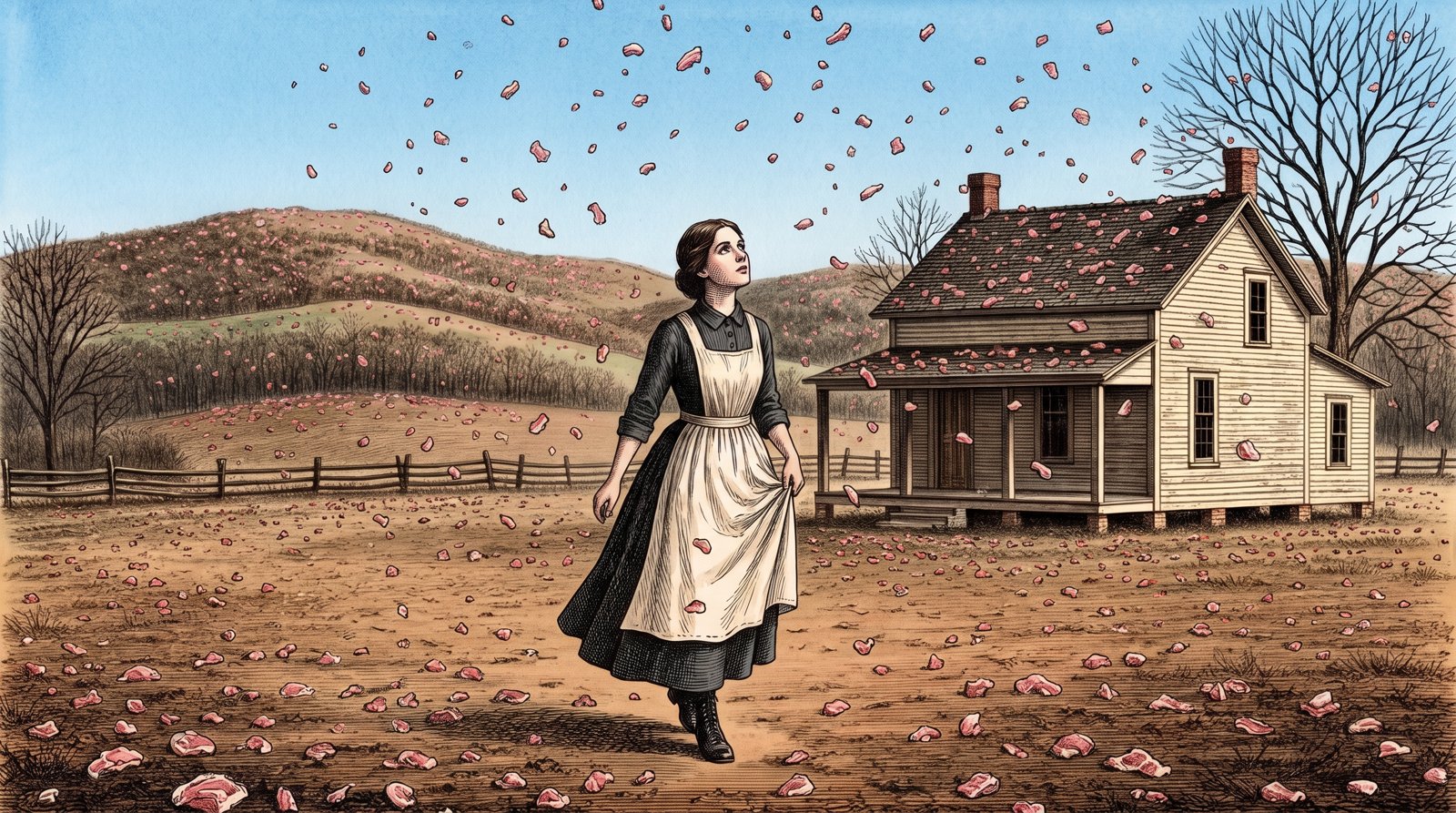
There is a yard, and a woman standing in it, and the sky above her is particularly clear. She is working outdoors over a kettle, at that old business by which a housewife turns scraps of meat and bones and worn-out overshoes into soap. It is a Friday in early March, 1876, in Kentucky.
Then it begins to fall. Not rain. Meat. A gentle shower of it, drifting down out of a sky with nothing in it. Flakes of raw flesh from the size of a pea to the size of a finger, thin, the color of fresh-cut meat. They land in the grass, hang on the fence rails, stick to the leaves. Her cat gets to it first and gorges himself on the sudden public breakfast. By the time it stops, the ground is covered for a mile around.
People come and gather up the flesh. Then, because they are country people and it looks like supper, they taste it. One says mutton. Another says beef, underdone. A third says pork, and a fourth swears it is venison, upon his word. An old woman called Aunt Dinah says the fall is doom, and that a witch has fallen off her broom.
That is the tale: the clear sky, the soap kettle, the cat, the arguing tasters, the omen. Some of the flesh went to Louisville in a bottle, and from the moment it did the tale began coming apart at the edges. A good many of the ornaments above turn out to be traceable no further than a humor column or a comic poem. What is left underneath them is stranger, better attested, and nobody’s joke.
The Names in the Record
The name Harrison Gill reaches us through a comic verse titled “Meateoric Shower,” credited to the New York Graphic, which has the shower spill “Upon the farm of Harrison Gill, / Who lives with his wife and cows and things / In Old Kentucky—Olympian Springs.” We hold it in two printings: one dated March 23, 1876, on the same page as the Louisville Courier-Journal interview, and one in the Bismarck Weekly Tribune of April 5, 1876. The same verse supplies the mile of ground, the tasting rustics and Aunt Dinah, and closes with a postscript reporting that news from Louisville says nobody can find any Harrison Gill, and that the Olympian folks call it one of Old Allen’s jokes, a hoax. The name Crouch appears instead in the New York Times column of William Livingston Alden, which is contemporaneous with the event and reached Vermont readers in the Burlington Weekly Free Press of March 31, 1876, eight days after the earlier of the two printings of the verse that we hold; it names Mrs. Crouch of Olympian Springs. Among the later retellings we have read, Leland Gregory writes of Mrs. Allen Crouch in her yard making soap, and Chet Stover of a gentle shower of meat descending on Mrs. Crouch of Olympian Springs, while the one assertion we hold from Kathryn Walker names no farmer at all, placing the fall only in Bath County, Kentucky, on a clear day in March 1876.
A name close to it does appear in the reporting, and there it belongs to a neighbor rather than to the farm. In the Louisville Courier-Journal’s interview, reprinted on March 23, 1876, Captain J. M. Bent placed the fall in Bath County near “Harry Gill’s Mudlick Sulphur Springs,” about seventeen miles east of Mount Sterling, and said that Harry Gill, of Mudlick Springs, a gentleman of very high reputation, and a hundred others would furnish affidavits if necessary. Whether the verse took its Harrison Gill from Bent’s Harry Gill, the record does not say; nor does it settle whether anybody in Louisville really went looking for him, since the searching is reported only inside the comic verse.
The farmer in the reporting is Crouch. L. D. Kastenbine, professor of chemistry in the Louisville College of Pharmacy, opened his report in the Louisville Medical News of May 20, 1876, on “the strange phenomenon which occurred on the farm of Mr. Crouch, in Bath County, last winter.” Bent put it on farmer Crouch’s place near Mudlick Springs, and said Crouch’s wife was standing in her doorway when she saw the particles and called others to witness them.
The census records two candidates. An Allen Crouch, white male, aged 32, farmer, born in Kentucky, appears at dwelling 8, family 8, White Sulphur Precinct No. 5, Bath County, in 1880; an Allen Crouch household appears at dwelling 172 in the county’s Seventh Precinct, called Tanyard, including Margret, a white female aged 37, listed as daughter and at home. An Allen T. Crouch married Rebecca Staten in Bath County on December 9, 1837. A Kentucky death certificate filed in Bath County in 1917 records Algin Crouch, a white married male, dead on May 25 at 69, buried the next day in Dickerson Graveyard, J. W. Vaughan of Salt Lick undertaker, with the names of both his father and mother entered as unknown. Certificate 3373, filed February 26, 1918, records Elizabeth Crouch, daughter of Greenberry Moore, born in Virginia, the informant being Leander Crouch of Salt Lick. Which of these households, if any, is the yard in question, we cannot determine from the record we hold.
The ground itself is documented. The Kentucky Geological Survey at the University of Kentucky calls the topography of Bath County for the most part hilly to mountainous: Tater Knob at 1,388 feet, six miles southeast of Salt Lick; South Knob of Big Mountain at 1,384; Carrington Rock at 1,340; Mount Olympus at 1,201; Owingsville, the county seat, at 1,000. The St. Louis Globe-Democrat, writing in 1889, said the fall took place in a spot surrounded by high hills and mountains, which is at least the right kind of country.
Two Clocks and Two Measures
On what happened, the record speaks with more than one voice, and the voices disagree about the hour. A Louisville dispatch dated March 10, 1876, printed in the White Pine News, put the fall at 2 p.m. on March 3, with the heavens clear, the sun shining, only floating clouds visible. Bent told the Courier-Journal the same: two o’clock last Friday, March 3.
Thirteen years later the St. Louis Globe-Democrat printed what it offered as Mrs. Crouch’s own account, reproduced as substantially accurate, and the Daily Kennebec Journal and The Morning News of Savannah carried it too. In it she says: “Between 11 and 12 o’clock I was in my yard, not more than forty steps from the house. There was a light wind coming from the west, but the sky was clear and the sun was shining brightly. Without any prelude or warning of any kind, and exactly under these circumstances, the shower commenced. The fall was of not less than one nor more than two minutes’ duration.”
Two or three hours apart on the clock, and agreeing on the thing that matters: sun overhead, and nothing between it and that yard that anyone thought worth reporting.
They do not agree on extent or duration either. The March 10 dispatch said the flesh covered two acres. Kastenbine wrote of an area of more than one hundred feet. Bent said the flakes settled on a space probably one hundred by two hundred yards, falling in scattering showers for about ten minutes. Mrs. Crouch’s account gives one to two minutes. We have found no account that says how any of these figures was arrived at.
The Monthly Weather Review records that on the morning of March 2, 1876, the ridge of highest atmospheric pressure could be traced from Minnesota south-southwestward to northern Texas. We have found in it no statement about the sky over one farm in Bath County.
What Fell, and Who Ate It
On appearance the early sources converge. Bent described flakes from the size of a pea to that of a human finger, rather thin, of regular flesh color, which in touching trees and fences left a mark similar to that of blood in its secondary condition; the substance was somewhat like mutton in appearance. The March 10 dispatch says the same: it resembled mutton and left traces of blood on the trees and fences the flakes touched.
Mrs. Crouch’s account is more particular and stranger. She saw a large piece strike the ground close by her “with a snapping like noise when it struck,” and was impressed with the conviction that it was a miracle or a warning. The largest piece she saw was as long as her hand and about half an inch wide, and “looked gristly, as if it had been torn from the throat of some animal.” Another was half round and about the size of a half dollar. The same 1889 account carries two local verdicts: an old hunter in the neighborhood, shown a piece, declared it bear meat with “that uncommonly greasy feel” peculiar to that animal, and a butcher persuaded to taste it changed his mind about swallowing any, declaring that it tasted neither like flesh, fish nor fowl — it looked to him like mutton, but the smell was a new one. Some of the meat was quite dry, that account adds, with a fine, wool-like fiber running through it. We have found no record of any laboratory addressing the bear-meat identification; on the mutton, Kastenbine wrote that a number of meat experts pronounced the odor of his specimen mutton without hesitation, and that some had even asserted that the wool of the animal was distinctly seen.
As to who ate it, the earliest interview is specific in a way the legend is not. Asked whether any was eaten, Bent answered: “Yes, sir — by the hogs and chickens, which gathered in large numbers, and devoured the flakes with evident relish.” He added that a Mount Sterling butcher who was in Bath County at the time shaved off a piece with his knife, roasted it, called it palatable, and could not tell what animal it came from. Bent also said that after the event was noised abroad people flocked around in dozens and gathered considerable of the flesh. So a human taster is there from the first: one butcher, roasting a shaving, unable to name the animal. The crowd of arguing tasters comes later that same month — an unnamed contributor to the Chicago Times, in an account carried on a page dated March 29, said that some men in Kentucky had eaten some of the fallen material in order to test it, and the New York Times column reprinted on March 31 has two Kentucky gentlemen in prosperous circumstances and accustomed to eating raw meat pronouncing it either venison or mutton.
The March 10 dispatch carried a line the legend never uses. Quantities of the flesh had been preserved — and, the dispatch went on, what was brought to Louisville had been given to Professor Lawrence Smith, who proposed making an examination the next day. Someone had put it in a bottle.
The First Answer, and Its Withdrawal
Bent was a retired lawyer and, the Courier-Journal said, a respected citizen of Mount Sterling, the gentleman who first informed the general public of the affair through that paper; the March 10 dispatch called him well known for reliability. He was also frank about his distance from it. Asked whether he had witnessed the occurrence he said no — his information came first from Judge Day, of Menifee, a perfectly reliable gentleman — and that hundreds were willing to attest the truth with affidavits.
Bent exhibited specimens to the Courier-Journal reporter, and the two took them to the residence of Professor J. Lawrence Smith. The particles had been preserved in alcohol and had changed to a dull red and white hue, somewhat withered. Smith said at first only that the substance seemed to be of an animal nature and that he would examine it further; asked whether decomposition affected the particles after falling, Bent said he thought so. The paper’s own flourish — that this was the most wonderful phenomenon ever known and would occupy the world of science for some time — is the paper’s, not a finding.
Explanations were already loose in the press. The White Pine News carried, beside its dispatch, a line reporting that a Louisville scientist explained the shower as spawn of frogs carried up from ponds by strong currents of wind; the scientist is not named. An analysis printed with the Courier-Journal interview on March 23 argued the same case at length, and our reading of that column takes it as Professor J. Lawrence Smith’s first published verdict: the matter gave every indication of being the ova of batrachian reptiles, taken up by currents of wind from ponds and swampy grounds and fallen where found; this was no isolated occurrence, the writer said, the only date he could fix being an instance recorded by Muschenbroek in Ireland in 1675, where the matter was gelatinous and fatty, softening in the hand and smelling unpleasantly in fire. He asked for more material and said he would make known any modification of his views. The reasoning is the same reasoning Smith later described as his own first reading, and the caveat about more material is worth holding onto, because he did modify his views.
What is documented is the reversal. In a letter to the Courier-Journal, noticed by The People’s Advocate and reprinted by The American Journal of Microscopy in May, Smith showed how thin the spawn theory’s basis had been: “In my first examination of this anomalous substance, I was furnished with two small specimens that had been in alcohol; one of them was so hard and dry that I did not undertake to examine it; the other being soft, I cut it across, and finding the interior of the mass gelatinous, I could see no other source of this gelatinous matter than the spawn of batrachian reptiles.” He sent what he had left to Professor Putnam, of Salem, and had not yet heard his results; we have found no record of Putnam’s findings. Two further specimens reached him, one examined by A. T. Parker of Lexington, who also sent mounted preparations. “I have examined both the specimens and the preparation,” Smith wrote, “and am perfectly satisfied that they contain muscular fibre, and therefore cannot be, as I first supposed, reptilean spawn. The matter appears to be mixed; some of it is muscular, some cartilaginous, others gelatinous and fatty.” Learning in conversation that Dr. Kastenbine had reached similar results, he called the two microscopists’ work conclusive, abandoned his theory, and said the whole question was reopened and might as well seek its solution through the public press.
The retraction traveled slower than the theory. A writer signing himself F. C. in the Providence Morning Star that May complained that a class of writers, presuming on a naturalist’s good nature, had headed their accounts with his name and called the affair a rain of “dry frog-spawn.” Kastenbine recorded a different objection: a naturalist told him it was not the season for spawn.
The Bench in Louisville
Kastenbine’s report is the nearest thing the record holds to a laboratory notebook. He wrote that the phenomenon on Mr. Crouch’s farm had drawn considerable attention not only from the press but from many learned societies and private individuals; that many were disposed to treat it as “scientific bait,” others as batrachian spawn scattered by a whirlwind. Hearing the week before that a vegetable fungus was the latest identification proposed, he decided to examine one of five specimens given to the pharmacist Simon N. Jones by Dr. Luke P. Blackburn. It came to him in a morphine bottle labeled with a clipped paragraph from the Courier-Journal, which noted that specimens were now very scarce, and that Jones’s appeared dry but resembled animal flesh and were somewhat greasy.
What he did with it was crude and decisive. Heating a small portion on a platinum spatula over a Bunsen burner, he found that it melted and burned with a “spurting flame,” the grease running out toward the handle; the odor on warming was distinctly like rancid mutton-suet, and after ignition had the characteristic smell of burned animal tissue. He then cut thin sections from a portion with no woody matter adhering and treated them for twenty-four hours with dilute chromic acid, chromate of potassa, iodine serum and common salt. All brought out the muscular fiber, but the common salt rendered the striae exceedingly distinct, showing it to be a portion of voluntary fiber. Connective and fatty tissues were also clearly shown.
On the species his own words are more careful than the retellings. Because the specimen had not been placed in alcohol its odor was retained, “which a number of meat experts pronounced without hesitation mutton.” That is a smell test by unnamed experts, not a microscopical identification of the animal. He added that others had since reached the same conclusion, some even asserting that the wool of the animal was distinctly seen.
Brooklyn Said Algae
While Louisville was burning grease off a spatula, a wholly different answer was in print. Leopold Brandeis, of Brooklyn, published “The Kentucky Shower of Flesh” in The Sanitarian at page 222 of volume IV for 1876 — indexed twice in that volume, with his name misspelled BRNADEIS in the article’s running head.
He began with a maxim: “It appears to be a law of nature that weeds should grow with flowers, tares with corn, and that superstition should almost touch truth.” Showers of frogs, of fishes, of bloody rain and snow had frequently occurred; the last sensation, “the fall of flesh in Kentucky,” offered features of special interest. Want of rapid transportation and the perishable nature of fallen substances had hitherto prevented exhaustive examination, but “the specimens of the ‘Kentucky shower,’ however, reached this city well preserved in glycerine, and it has been comparatively easy to identify the substance and to fix its status. The ‘Kentucky wonder’ is nothing more or less than the ‘Nostoc’ of the old alchemist.”
The alchemist was Paracelsus, and the origin story comes to us only from the people telling it. Brandeis wrote that in 1537, while Paracelsus was engaged in the production of his elixir of life, he came across a very strange looking vegetable mass to which he gave the name Nostoc; the Watertown Republican and the Gloucester County Democrat repeated the same account in 1882, one of them dating it 1573 rather than 1537. Brandeis described a gelatinous growth of about fifty classified species; the spores, once out of their envelope, may be wafted by the winds and carried great distances, and where they find dampness or recent rain they thrive and spread very rapidly, many cases being on record of Nostoc covering miles of ground with long strings in a very few hours. “On account of this rapidity of growth,” he wrote, “people almost everywhere faithfully believe the Nostoc to fall from the clouds.” Icebergs afloat amid ocean had been found covered with it. Then the sentence that made the identification specific: “The flesh that was supposed to have fallen from the clouds in Kentucky is the flesh-colored Nostoc (N. carneum of the botanist); the flavor of it approaches frog or spring chicken legs, and it is greedily devoured by almost all domestic animals.”
Note what the account requires. It is not a theory of how flesh got into the air; it is a claim that nothing fell at all, that blown spores swelled into visible growth on damp ground. F. C. in Providence followed the same line that May, reporting that a gentleman writing in a late number of The Sanitarian had obtained specimens, proved beyond doubt their vegetable nature, and shown that instead of coming from the clouds the substance took root on the surface of the earth and increased rapidly by self-division — related, F. C. added, to “Gory Dew” and “Red Snow.” The reading kept circulating: in 1882 the Watertown Republican and the Gloucester County Democrat of Woodbury, New Jersey, both ran a short piece called “The Nostoc Plant” identifying Nostoc as the substance found in the so-called flesh showers, the New Jersey paper stating plainly that the belief in a shower of flesh from the upper regions was erroneous.
The Sanitarian was not a botanical journal. Its 1876 volume was occupied with epidemics, soap manufacture and mysterious disappearances — including a farmer near Baer’s Woods who noticed vultures hovering over a clump of trees and found them feasting on a portion of a human body thinly covered with earth and leaves. The journal that printed the algae explanation printed, in the same volume, a close description of vulture behavior around shallowly buried flesh.
Muscle, Cartilage, Lung
The American Journal of Microscopy, of New York, ran the case four times in its first volume, at pages 54, 69, 84 and 110. In April it reprinted Brandeis. In May it recalled having published a paper taking the ground that the shower was merely the rapid development of a species of Nostoc, reminded readers that Smith — a celebrated chemist, an able microscopist, and the inventor of the inverted microscope that bears his name — had pronounced it frog spawn, printed Smith’s letter, and reserved judgment: “That a novice might readily mistake the cellular structure of a nostoc for the striations of muscular fibre is not impossible, but that experienced histologists should be so deceived is, we think, highly improbable. The question, therefore, seems to be still an open one.”
In June it closed that question. “Since our last issue the substance which is said to have fallen from the sky in Kentucky has been carefully examined in this city by men of experience and ability, and has proved to be of undoubted animal origin. Through the kindness of Mr. Walmsley, of Philadelphia, we were enabled to examine a slide sent to him by Mr. A. T. Parker, of Lexington. This specimen was, without any doubt, striated muscular fibre. Since then we have received from Mr. Parker himself, specimens not only of muscular fibre, but of cartilage.” Then the sentence that undoes Brooklyn: “The identical specimens which were examined in Brooklyn, and pronounced by Mr. Brandeis and others to be Nostoc, have been submitted to experienced histologists, who find that they are lung tissue. Professor J. W. S. Arnold and Dr. A. Mead Edwards are, amongst others, the authority for this opinion.”
Three tissues, from three benches: voluntary muscle under salt in Louisville, striated muscle and cartilage from Parker’s slides, lung from Arnold and Edwards on the same glycerine-preserved material Brandeis had called an alga. The journal’s ruling ran to two sentences: “We therefore regard the question as to the nature of the material composing the so-called meat shower as no longer an open one. The source or origin of the meat is, however, still sub judice.”
One caution the record itself supplies. That journal, in the same volume, printed repeated warnings about confident identification under the lens. Its first number, cautioning those who employ cheap microscopes against attempting to go beyond the power of their instruments, quoted a celebrated microscopist who had been in the habit of using such inferior instruments as saying that with a power of 600 diameters “we may see whatever we want to see.” Its February 1876 piece “Science in the Court-Room” held that a witness who swore positively that a stain was made by human blood and no other kind “must be either very ignorant or very wicked, or perhaps both.” An editorial titled “Use and Abuse of the Imagination” observed that “it is the most common thing in the world to hear inexperienced microscopists describe things which exist nowhere but in their own imagination.” A. Mead Edwards, one of the two named authorities for the lung tissue, was himself a frequent contributor to that journal in 1876. None of this makes the lung finding wrong; it does mean the finding came from inside the house, and that the house’s published standard of proof was a strict one. The same volume also noted that mounted slides from previously reputable Continental makers were being sold fraudulently — worth remembering about specimens passed hand to hand across five cities.
Working Down the Explanations
Take the accounts in the order a reader is likely to hold them. First, that the material was never flesh but a peculiar substance capable of taking a flesh-like form in the atmosphere — the Nostoc reading of Brandeis and those who repeated him. It explains the flesh color, the hogs and chickens eating the flakes with relish, even the tasting, since Brandeis wrote that the flavor of flesh-colored Nostoc approaches frog or spring chicken legs, uncomfortably close to the comic verse’s rustics arguing mutton and pork. A joke agreeing with a theory is not evidence for it. And the explanation requires that nothing fell, while the earliest reporting has flakes marking trees and fences like blood in its secondary condition, and the 1889 account has a woman not forty steps from her house hearing a piece snap when it struck. What Brandeis claimed for rapid growth was miles of damp ground covered with long strings in a very few hours; the leaves and fence rails of the Bath County reports he does not address at all. Above all, the identical Brooklyn specimens came back, on the journal’s own account, as lung. The Nostoc reading stands in the record as what Leopold Brandeis of Brooklyn published in The Sanitarian and others repeated, not as something the later examinations left standing.
Second, frog spawn lifted by wind from ponds and swampy ground — the earliest explanation in wide circulation, carried by a Louisville scientist the White Pine News did not name and argued at length in the unsigned March analysis. It was abandoned by Smith in print on the grounds that two careful microscopists found muscular fiber, and met by the naturalist who told Kastenbine it was not the season for spawn. Whoever first advanced it, no one in this record defends it after May.
Third, buzzards. The American Journal of Microscopy credited the idea to Professor Robert Peter of Lexington, through whom Smith obtained Parker’s specimen, who thought the fall was simply a kind of post-prandial disgorging by a flock of buzzards who had been feasting more abundantly than wisely on the carcass of a sheep — and in Smith’s published letter the sheep is followed by an aside that it was perhaps one of those animals that had undergone a strychnine preparation by some outraged Granger inimical to dogs, though the record does not establish whether that flourish was Peter’s or Smith’s own. Smith wrote that he was informed it is not uncommon for buzzards so to disgorge, and that when one in a flock begins the others are excited to nausea, so that a general shower of half-digested meat takes place. “Who knows but this is the true inwardness of the whole matter?” he wrote, and left it. Kastenbine credited the same idea to an old Ohio farmer and called it the only plausible theory, holding that the variety of tissue — muscular, connective, fatty, structureless — could be explained only this way, the particles scattered from an immense height by the prevailing wind. Which man said it first, the record we hold cannot say.
The buzzard account has one piece of contemporaneous support and one large hole. The support is Georgia. The Columbus Enquirer of June 10, 1876, reported that a few days earlier Dick and Ab. Kervin were standing in the back yard of the latter when quite a shower of flesh fell upon and around them; it seemed at first a miracle, as they had often heard of flesh raining from above; they cast up their eyes, discovered several buzzards about 100 feet overhead, and this explained the mystery, “and one, too, which has so often occurred and been unexplained.” The Enquirer added that as a Louisville professor had suggested, this might account for the famous Kentucky shower — and, with unusual care, that the Columbus particles were not gathered or analyzed as the Kentucky ones were. The hole is that in the Kentucky reporting no account we have found mentions a bird, and Mrs. Crouch’s words are “without any prelude or warning of any kind.” The extent is hard to reconcile as well: more than a hundred feet by Kastenbine, one hundred by two hundred yards by Bent, two acres by the March 10 dispatch. That is a great deal of ground for a few sick birds, and Kastenbine’s answer — immense height and the prevailing wind — is an assertion, not a measurement. Nothing in this record rules the buzzards out; nothing in it shows them either. By 1889 the St. Louis Globe-Democrat was calling the theory the simplest and perhaps the most satisfactory explanation that could be given of the supposed miracle, in the same column in which it said the affair was hardly susceptible of a thoroughly satisfactory explanation.
Fourth, transport by a distant windstorm. The Fanciers’ Journal and Poultry Exchange argued that worm showers in Norway were similar to the meat showers of Kentucky — worms found crawling on snow after a violent storm, with no crevices in the frozen ground from which they might have crept — and that the explanation was the same in both cases: material lifted by wind-storms with their centers in distant localities, carried up and dropped again. A Beaufort, South Carolina paper printed the same argument on May 11, 1876, citing the Morgenblad of Christiania, and oddly described the Kentucky material lifted and dropped as frogs and lizards. Whatever the merits of whirlwind transport in general, this version gives no reason why muscle, cartilage and lung should come down together on one yard, and the only wind in the eyewitness account is light, from the west.
Fifth, hoax. It was suspected in 1876, not invented since — the Graphic’s postscript reports the Olympian Springs people calling it one of Old Allen’s jokes. A contributor to the Chicago Times offered a precedent: about 1833 or 1834 a remarkable shower of flesh and blood fell in the night in a tobacco field near Lebanon, in Wilson County, Tennessee, and next morning the men going out to work saw particles of meat and spots of blood on the leaves and cried out, “A miracle! a miracle!” Mr. Tarpley, the owner, called in neighbors who with one voice decided it was animal matter, and sent a quantity to Dr. Girard Troost, a chemist and naturalist then a professor in the University of Nashville, who promptly pronounced it meat and bloody matter — without being under the necessity, the writer noted pointedly, of eating any of it, as it was said some men in Kentucky did. Theories were suggested, discussed and laid aside, some as wise as those then advanced about Kentucky. Then, the writer reports, some of Tarpley’s workers let it out that they had taken a dead hog, chopped it into small pieces and scattered it broadcast over the field as a practical joke. By his own account, he had been a student in the University of Nashville soon after the event, and after graduating spent a year in Lebanon, where, he says, the trick was still talked about. His moral — that wise theories about Kentucky should be withheld until time let out the secret facts, as it had in Tennessee — he offered as a suggestion, and it is worth taking as one. It is not a finding about Bath County. A Kentucky hoax must survive muscle, cartilage and lung reported from two sets of laboratories on material traced through named hands; somebody with a slaughtered sheep clears that bar as easily as a buzzard does. What no version of it explains, on this record, is a woman standing in her own yard describing a fall she took for a miracle or a warning, while the sun shone.
Where the Record Leaves It
The specimens acquired a price fast. The Public Ledger of Memphis, on April 25, 1876, quoted an unnamed New York advertiser: “I went to Kentucky, procured and have twenty genuine samples of the famous Kentucky meat shower, in alcohol, in twenty separate jars, which I will send C. O. D. for ten dollars per sample.” That is one announcement, and the advertiser’s claim to have gone and got them is his own; we have found no record of a sale, and no record of what was in the jars. It is still worth remembering before trusting the provenance of any surviving one. Evelyn Schultz, reporting for LEX 18 in Lexington, has said that among the holdings of Transylvania University’s Monroe Moosnick Medical and Science Museum is a possible sample of the Kentucky meat shower; the museum guide’s reading list includes Kurt Gohde’s article “Transylvania’s Meat Rain,” in Transylvania Treasures, volume 4, number 1, Winter 2013, pages 12-13.
The story also became a unit of measure in the papers. The Bellows Falls Times of March 17, 1876, told readers they might or might not take stock in it, noted that the attention of “Old Probs” had been called to the matter, and quoted the New York Evening Post’s view that, times being a trifle hard, news of a food supply of this sort was important to dwellers in cities — along with the Post’s sample weather prediction of the future: “For New England, the Middle States and lower region, falling barometer, increasing cloudiness with beef steaks changing to mutton chops in the northern part of these regions during the night.” The Marietta Journal of March 24 reported, under “Of-Hand Local Dots,” that Georgia, unwilling to be outdone, had eclipsed the affair when Grassy Pond in Lowndes County, a lake of five acres, emptied itself through a subterranean passage and left millions of fish on dry land; on the same page, under “Current Dots,” it reported that the Bath County shower had provoked a religious revival among the colored population there, who sat in little groups with faces turned upward and sang of the Lord throwing the victuals down. The Redwood Gazette held the Kentucky shower rendered thoroughly insignificant by a fall of wild geese in Dutchess County, New York — less mysterious, it conceded, because the geese were seen when the storm struck them. The New York Times supplied a “Terrific Fall of Cats” on a single city lot on Van Ness Street, San Francisco, in which the object of satire is not the fall but the investigating scientist who “invented a small boy” to explain it. By April 29 the New Orleans Republican was disposing of the whole business in a line: “The Kentucky meat shower was only a short rain of flesh.”
Several of the best-loved details are traceable, in what we have read, no further than a humor column. The soap kettle and the cat come from William Livingston Alden’s New York Times piece, reprinted in the Burlington Weekly Free Press of March 31, 1876, which has Mrs. Crouch of Olympian Springs employed in the open air under a particularly clear sky in those rites by which the housewife transmutes straps of meat, bones and effete overshoes into soap, the shower falling impartially on her and her cat, the cat gorging on the public breakfast. The same column gives the hash-like particles from a shred as light as a snowflake to a lump three inches square, the two prosperous Kentucky gentlemen who pronounced it venison or mutton, the absence of bone or buttons under the most searching analysis, and the scientific men who would hoot at the theory they would ultimately adopt while proposing the explosion of a cattle steamboat or nitro-glycerine tied to a large dog’s tail. Its closing images — most of Kentucky covered with baskets and tubs set in open fields to catch the next shower of atmospheric hash — are burlesque, and meant as such. Later books repeat the soap-making and the gentle shower as flat fact; one adds mourners caught in a shower of meat mixed with animal fur. We have found no source close to the events that puts a soap kettle in that yard, and none at all that mentions mourners or fur. Charles Fort wrote that material reported from Kentucky had been examined by Leopold Brandeis, and quoted an unnamed source declaring that a proper explanation had at last been obtained; Brandeis’s own article says the specimens reached his city in glycerine, and that is as far as this record goes.
Two things are established beyond argument. An event known as the Kentucky meat shower occurred in 1876. And on Mr. Crouch’s farm in Bath County there was, in Kastenbine’s own printed words, “a fall of quivering flesh from a cloudless sky, covering an area of more than one hundred feet, adhering to leaves, fences, etc.”
Everything after that is somebody’s name attached to somebody’s answer. An unnamed Louisville scientist said frog spawn, and an unnamed analyst argued it at length in March. Smith said the substance seemed animal, then published spawn, then unsaid it. Brandeis said Nostoc carneum and was overruled on his own slides. Kastenbine said mutton, on voluntary fiber under salt and a number of meat experts who smelled the bottle. Arnold and Edwards said lung. Peter said buzzards, and an old Ohio farmer may have said it first. An old hunter said bear, by the greasy feel. A butcher who tasted it said it was neither flesh, fish nor fowl, and the smell was a new one.
In June 1876 the American Journal of Microscopy set down its ruling in two sentences, and on the same page was still calling the material “the substance which is said to have fallen from the sky in Kentucky.” On that journal’s account the nature of the material was no longer an open question and its source or origin was still sub judice. That is where the record leaves it, and where we leave it too.